

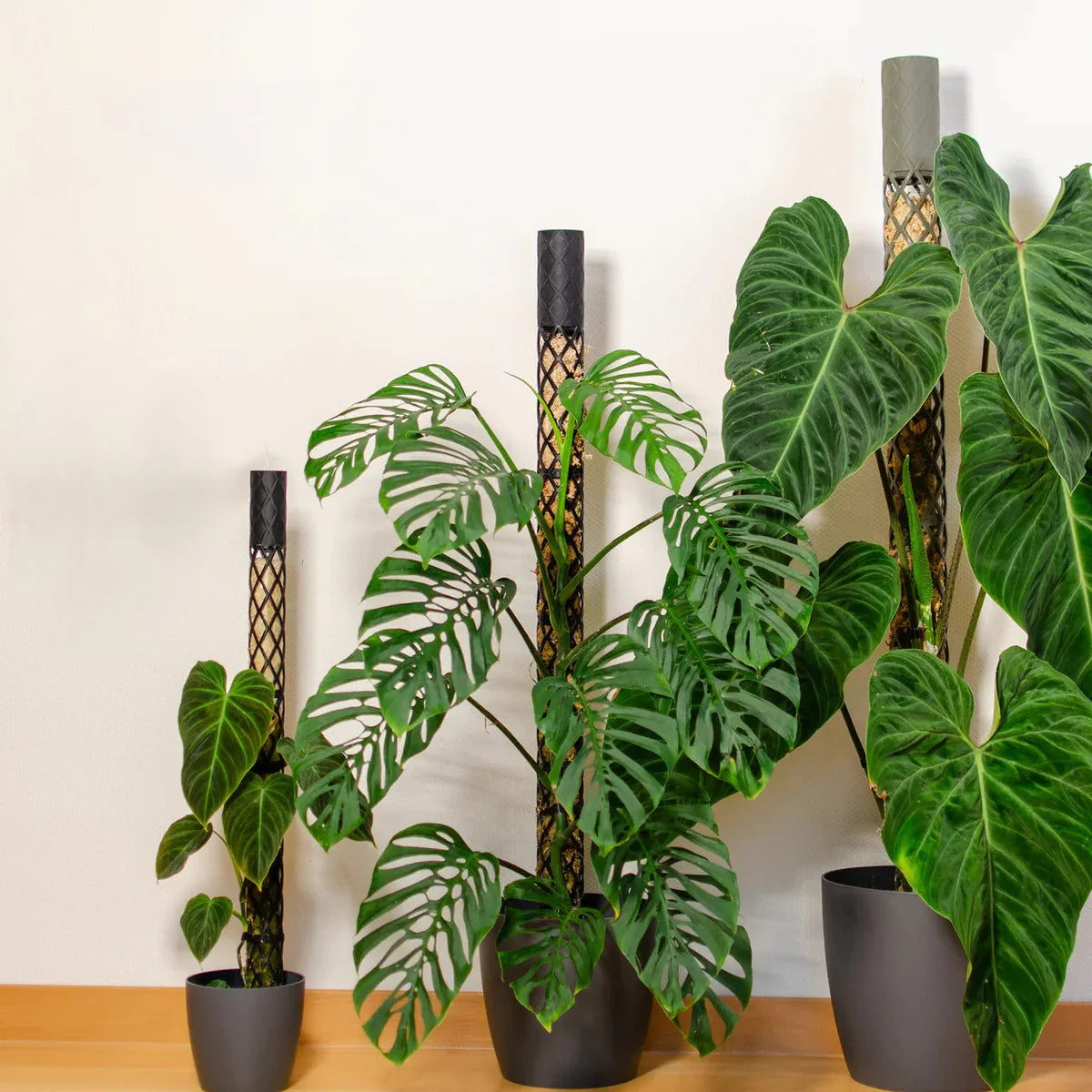
For which plants is a moss stick suitable?
- Monstera
- Philodendrons (some Philodendrons tend to creep over the ground and do not require a moss stick)
- ivy plants
- Anthurium
To understand why a Monstera, Philodendron, Pothos or Anthurium benefits from a moss stick, let's take a look at the natural growth of these plants.
The natural growth of Monstera, Philodendron and Co.
A Monstera that has randomly sown itself in an open space initially grows close to the ground until it eventually finds a tree. In the rainforest, there is little light on the ground. To get more light, the Monstera begins to climb up the tree. To do this, it uses its aerial and adhesive roots that form in each leaf axil (node). The plant uses these roots to cling to the tree and also absorbs moisture and nutrients from the humid climate.

As the plant climbs and adapts to the vertical direction, its growth changes. The distance between the leaf axes (internodes) becomes smaller and smaller, and the leaves grow larger - all in order to get more light.
So why does a Monstera want to find a tree? The plant wants to produce seeds as quickly as possible in order to reproduce. Since light is scarce on the forest floor, it has to grow upwards to get enough light and thus energy to form flowers. It can climb up to 20 meters to form its flowers and later seeds.
Climbing and clinging to a tree has a major impact on the plant's growth process. We can imitate exactly this natural process with a moss stick.
Why should every Monstera, every Philodendron, every Pothos and every Anthurium get a moss stick to climb on?
A moss stick allows the plant to develop just as it would in nature. It provides support and a moist environment for the aerial roots, allowing the plant to absorb nutrients and water - just like in the rainforest.
Moss stick vs. coconut stick vs. climbing aid
coconut stick:
A coir stick is a simple tube wrapped in coconut fibers. While it serves its purpose, it does not actively promote the growth of the plant and is difficult to extend.
Climbing support:
A trellis is usually a simple pole or frame that only serves as support but does not offer any specific advantages for growth. There is no support for aerial roots here. The plant can only lean on it.
Moss stick:
A moss stick consists of an external frame filled with sphagnum moss that is kept moist. The plant can grow its roots into it, develop its root system and absorb water and nutrients. The moss stick is also modular and easy to water.

Why is the waterable moss stick best for my plant?
With a moist moss stick we can ideally imitate the natural environment of the plant. In our rooms the humidity is usually between 40 and 60%. In the tropical rainforest, however, the humidity is almost 100% and there is frequent rainfall. A dry coconut stick is not sufficient here, as it does not store enough water and nutrients. Spraying the plant also has little effect, as the coconut stick does not store enough of these.
(Philodendron verrucosum: The front aerial roots have dried out due to the low humidity. The rear aerial roots, on the other hand, are rooted in the moist moss stick.)

Many philodendrons have dried out aerial roots after just 1-2 weeks. However, when these roots come into contact with a moist moss stick, they immediately grow into it and form a strong root system. Roots that would dry out in the dry conditions in our homes find the moisture and nutrients they need in the moist interior of the moss stick.
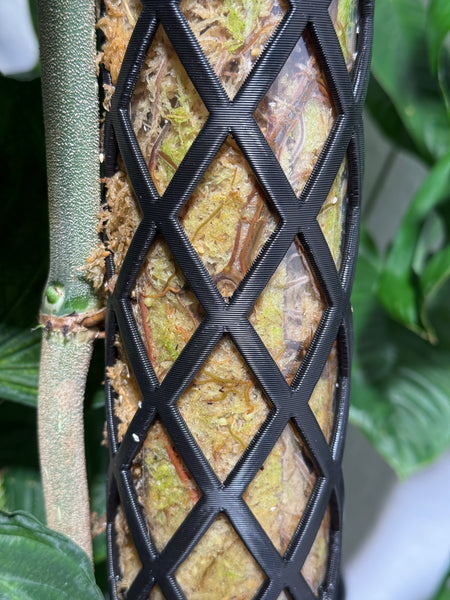
In addition, we can use the “Chop and Extend” method to keep the plant growing to the desired size. ( Read more about this in our blog post about “Chop and Extend ”).
Conclusion: Why a waterable moss stick is so important
A regularly watered moss stick perfectly imitates the plant's natural environment. Under these conditions, the plant develops optimally, forms larger leaves and grows faster. A waterable moss stick is therefore indispensable for Monstera, Philodendron, Pothos and Anthurium.
PlantMe Moss Stick Maxi

Chop and Extend – For long-term beautiful plants
Aroid Mix: Die beste Monstera Erde & Philodendron Erde (inkl. Mischanleitung)